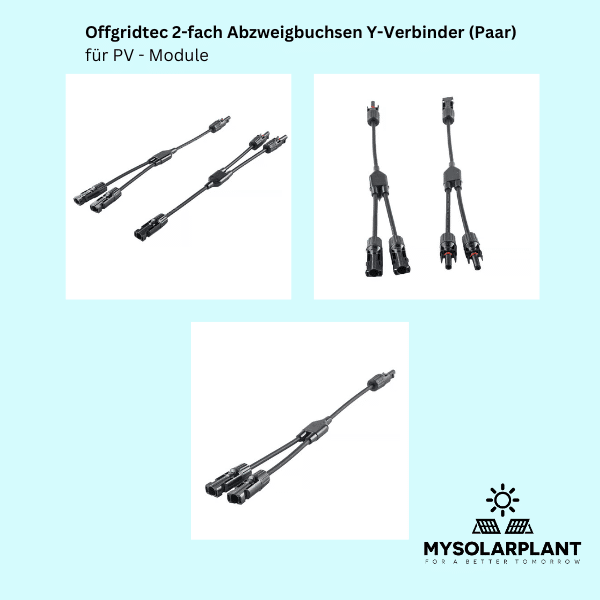
Offgridtec 2-Port Splitter Sockets, Y-Connectors (Pair)
9,00 €
Includes 0% VAT; shipping costs not included
Guaranteed Secure Payments
Description
🔌 Offgridtec 2-Port Y-Connector Splitter Sockets (Pair) with Extension Cable
For safe and efficient parallel connection of your solar modules
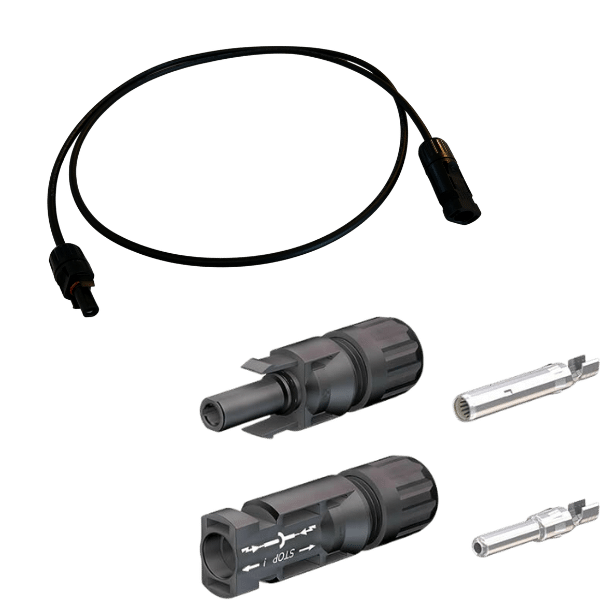
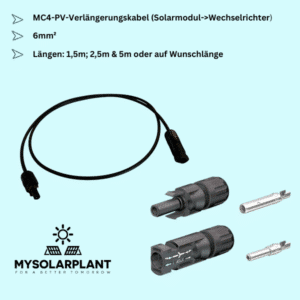
With the high-quality Offgridtec 2-port junction boxes, you can easily connect two solar panels in parallel. Thanks to the built-in cable extension (total length approx. 34 cm), you have more flexibility during installation—ideal for use in portable solar systems, on boats, in RVs, or in stationary off-grid systems.
🌞 Benefits at a Glance
-
Quick Parallel Connection: Simply connect two solar panels—positive to positive and negative to negative
-
Compatible with solar connectors: Fits perfectly with standard PV systems
-
High IP67 protection rating: Dust- and water-tight when plugged in—ideal for outdoor use
-
Large wire cross-section: 6 mm² for low losses and maximum efficiency
-
Easy-Click System: Secure hold thanks to the snap-in lock—no accidental release
-
Ideal for 12V systems and thin-film modules
⚙️ Technical Specifications
| Characteristic | Description |
|---|---|
| Manufacturer | Offgridtec |
| Model | 2-way splitter sockets with extension cord |
| Part Number (MPN) | 010337 |
| EAN | 4250983259780 |
| Cable Cross-Section | 6 mm² |
| Compatible with | Solar Connectors |
| Protection Class | IP67 (when plugged in) |
| Weight | 0.1 kg |
| Total length | about 34 cm |
| Category | Installation |
💡 What does “parallel connection” mean?
In a parallel connection, the positive and negative leads of several solar modules are connected to each other.
This increases the current (amps), while the voltage (volts) remains the same.
Example:
Three 100W modules (Imp = 5.56A / Vmp = 17.8V) are connected in parallel.
Total power:
Imp = 16.68A, Vmp = 17.8V → perfectly matched to a 20A charge controller with a maximum input voltage of 30V.
📦 What's Included
-
1 pair of Offgridtec 2-way Y-connectors, including extension cable
➡️ Offgridtec stands for quality, durability, and ease of use—choose proven brand quality for your solar system!
Frequently Asked Questions
How large can a balcony power plant be without a permit?
In Germany, balcony power plants—also known as plug-in solar systems—may be operated with a capacity of up to 600 watts without a special permit. However, you must still register systems of this size with your local grid operator and the Market Master Data Registry. Operating such systems without registration can have legal consequences. It is important to always check with your grid operator and review the current regulations to ensure that all requirements are met.
When is a balcony power plant worth it?
A balcony solar power system is particularly worthwhile in Germany if you use a lot of electricity during the day, since you can use the electricity you generate yourself right away. By optimizing your self-consumption, you can lower your electricity costs. The payback period depends on various factors, such as the purchase cost, the current electricity price, and the amount of sunlight. Generally, a balcony solar power system can pay for itself within a few years. You’ll also be contributing to the energy transition and reducing your carbon footprint.
What is a balcony power plant?
A balcony power plant—often referred to in Germany as a "plug-in solar system" or "mini solar system"—is a small photovoltaic system that is connected directly to a home’s electrical grid. These systems are frequently installed on balconies, patios, or even on building facades. With the help of an inverter, the direct current (DC) generated is converted into alternating current (AC) and can be fed directly into the home’s electrical system via a standard outlet. Their primary purpose is to reduce one’s own electricity consumption and contribute to sustainable energy production.
How does a balcony power plant work?
A balcony power plant typically consists of one or two solar panels and an inverter. The solar panels convert sunlight into direct current. This direct current flows into the inverter, which converts it into alternating current that can be used by household appliances. The balcony power plant is then connected directly to the home’s electrical system via an outlet. This allows household appliances to use the solar power generated directly. Excess electricity that is not consumed immediately can be fed into the public grid, provided the system is properly registered with the grid operator.
Downloads
- Inverter Data Sheet
- Panel Data Sheet
- Inverter Certificate
- Panel Data Sheet